The images that saved the vaults
The 1997 earthquake, the Mirabilia Italiae photographic campaign and the reconstruction of the frescoes in the Upper Basilica
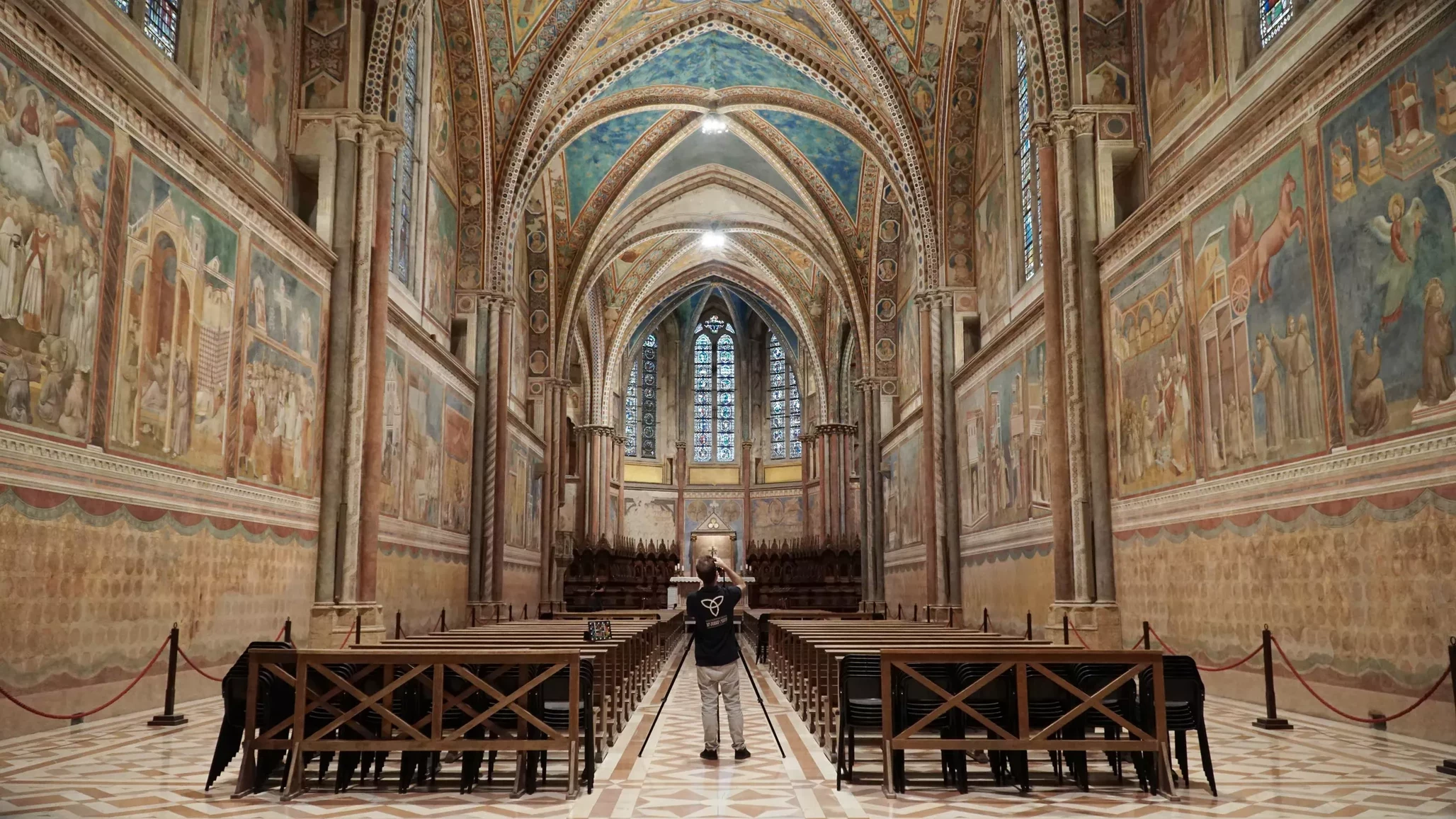
In the 1990s, the publishing house Franco Cosimo Panini started an extensive photographic campaign of the Basilica of Saint Francis. The aim was to create a systematic record of the entire complex, from the major painted cycles to details that were otherwise difficult to access.
Following the earthquake of 26 September 1997, which caused sections of the Upper Basilica vaulting to collapse, photographs taken before the disaster enabled restorers to identify the fragments and reconstruct the frescoes with accuracy.
Originally produced for a publishing and research project, these images became an essential tool in the reconstruction process.
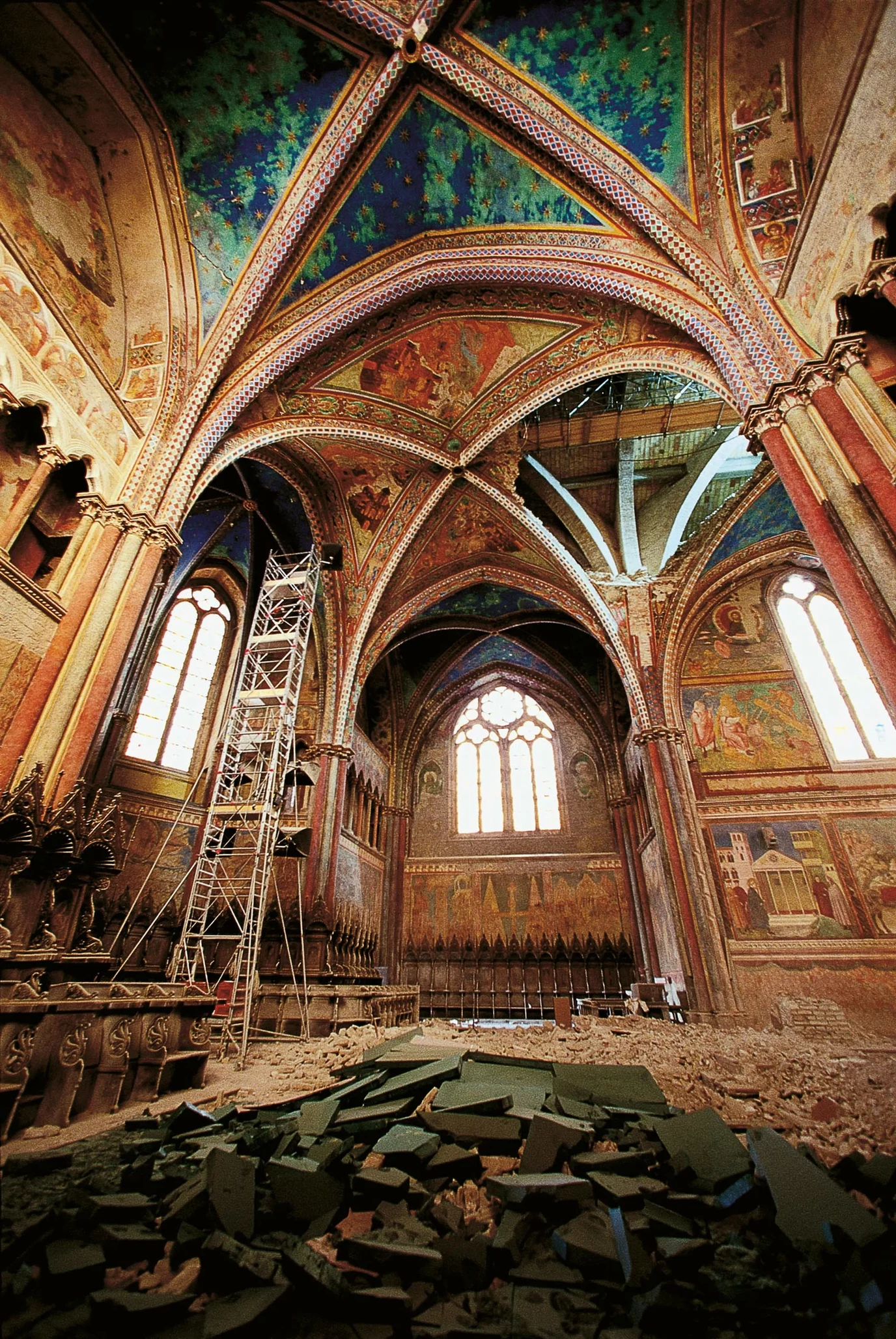
Before the collapse: an atlas of the Basilica
The photographic campaign carried out by Franco Cosimo Panini Editore had been carefully planned for the volume on the Basilica of Saint Francis in the Mirabilia Italiae series.
The series is an ambitious publishing project conceived as an atlas of Italy’s great monuments, documenting each one in its entirety and following a rigorous topographical sequence. The photographs are accompanied by diagrams, captions, essays and art-historical entries that allow every detail to be located and understood in context. Together, they convey the complexity of each monument, the works of art it contains and the relationships between its different parts.
The photographic campaign for the Assisi volume lasted six years and produced around two thousand images of the interiors and exteriors, the architecture and the decorated surfaces.
Just a few hours before the earthquake, the vaults of the Upper Basilica had been photographed. Those same vaults would collapse shortly afterwards.
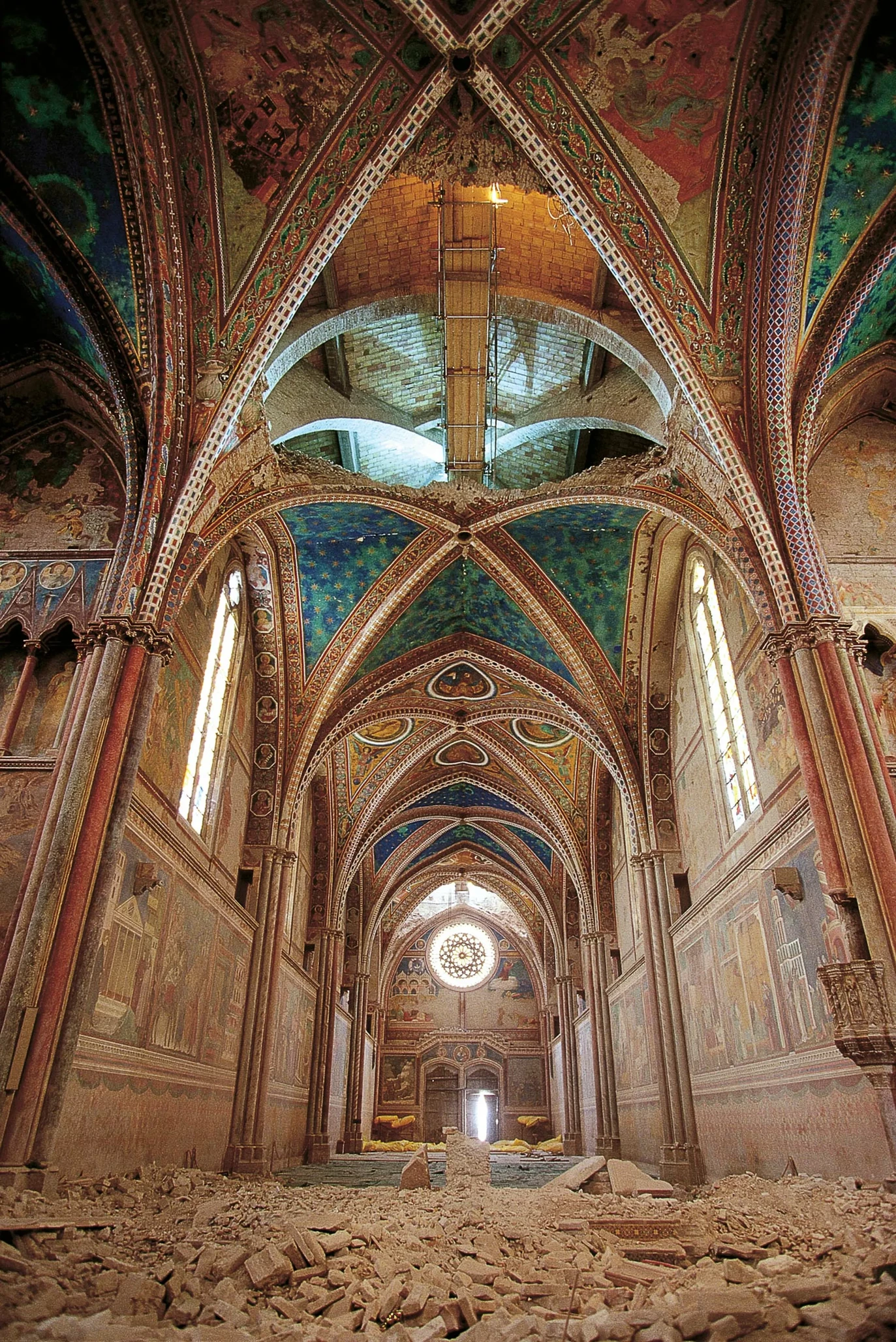
The collapse of the vaults
On 26 September 1997, a powerful earthquake struck Umbria and the Marche. Sections of the vaulting in the Upper Basilica collapsed, bringing the frescoed surfaces down with them.
In a matter of moments, masterpieces by Giotto and Cimabue, admired for centuries by millions of visitors and worshippers, lay scattered across the floor of the Basilica in hundreds of thousands of fragments. Around 300,000 pieces were recovered, representing almost 200 square metres of wall painting.
VideoThe memory of the vaults
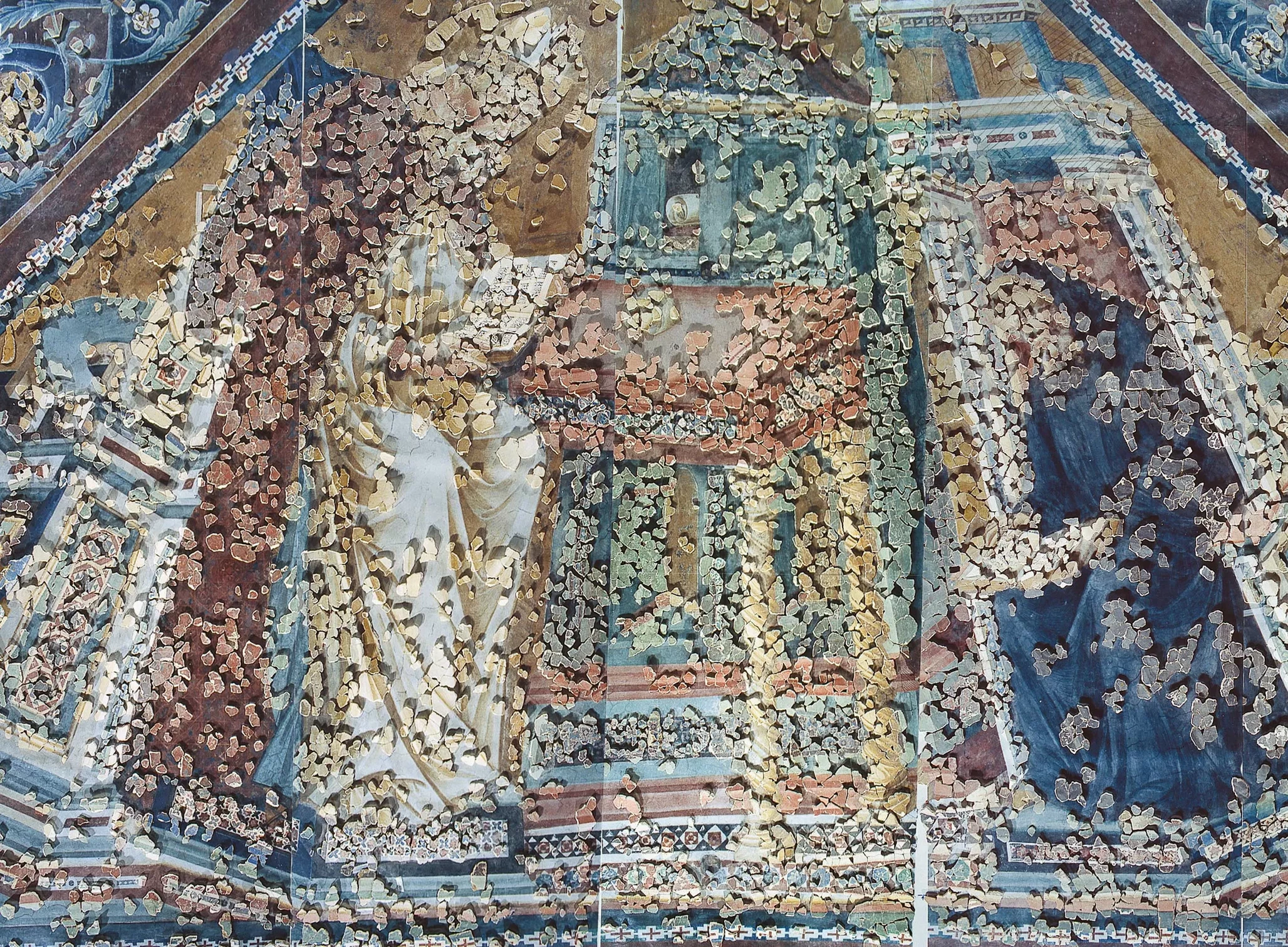
After the collapse, a painstaking and complex process began. The recovered fragments were collected, catalogued, sorted and gradually matched to the different areas of the decoration. The main challenge was to identify the original position of each fragment within a decorative scheme that had been destroyed. It was at this point that the full value of the photographic archive created for Mirabilia Italiae became clear.
Photographs of the vaults were printed at full scale and used as a reference for comparing shapes, colours and details, helping restorers identify possible matches between the pre-earthquake images and the recovered fragments.
In this way, the photographs gave restorers a visual reference for piecing the shattered masterpieces back together.
“The Panini photographic campaign carried out before the collapse was essential. Its photographs were printed at a scale of 1:1; without them, we could not have reassembled the fragments.”
Sergio Fusetti, head restorer of the Basilica of Assisi during the years of the earthquake
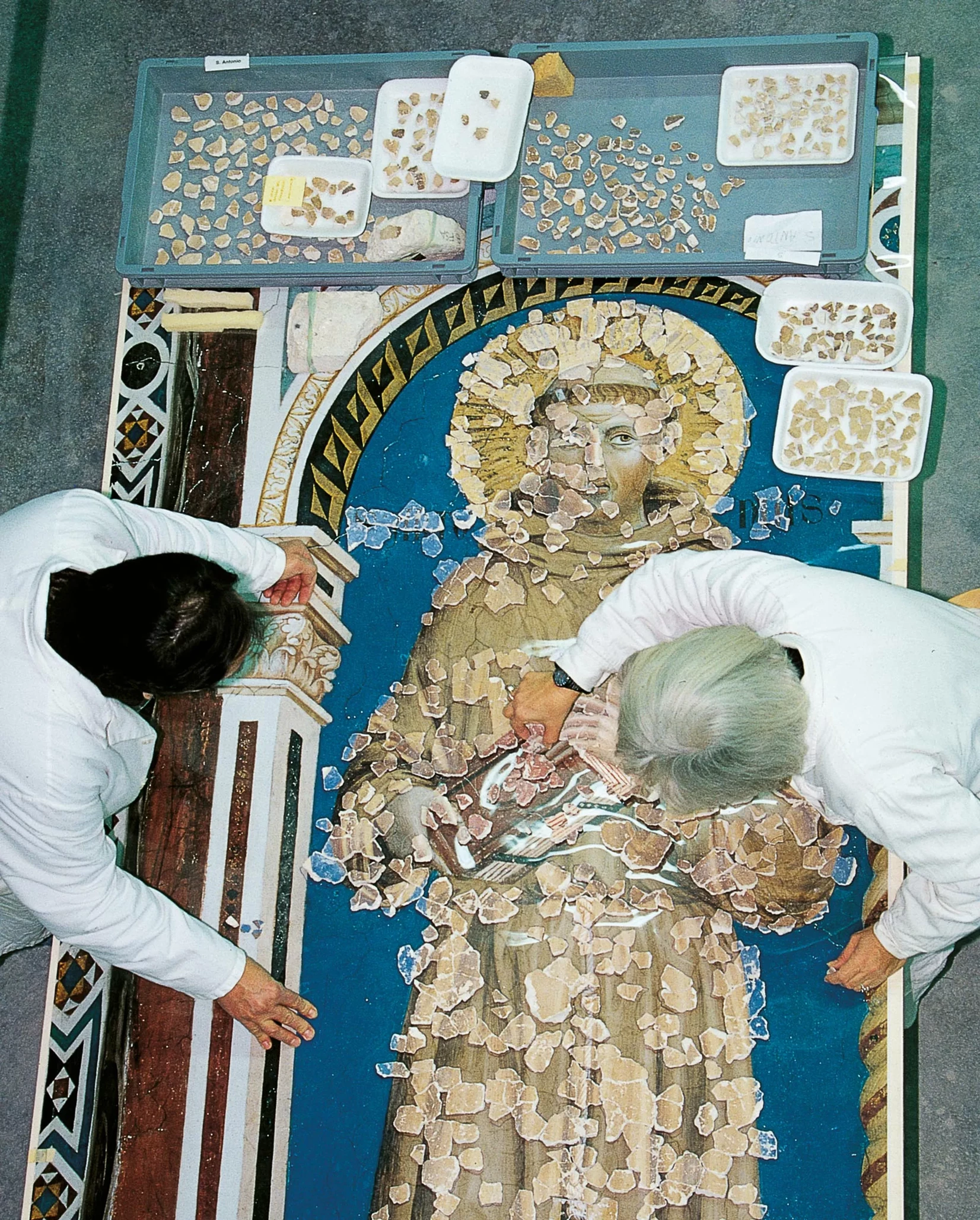
From photography to reconstruction
Reconstructing the vaults was a collective effort, made possible by the combined work of restorers, art historians and specialists involved in cataloguing and analysing the fragments.
The photographic archive thus took on a significance that went far beyond the publishing project for which it had originally been created. It became an invaluable reference throughout the long process of reconstructing the vaults and reopening the Basilica to the public.
A story that continues
The work carried out after the earthquake with the help of the Mirabilia Italiae photographs demonstrated the importance of documentation based on accurate and reliable data.
Today, Preserving Assisi continues that work using new tools. 3D surveys of the entire complex and gigapixel imaging of its painted cycles are creating an up-to-date visual record of the Basilica, supporting further research and helping to monitor its state of conservation.
From the Mirabilia Italiae volume to the Preserving Assisi platform, the tools have evolved as the technology has advanced. What has remained unchanged is the commitment to documenting the Basilica with the same degree of precision, so that this body of knowledge can continue to support the monument’s conservation over time.
Comparing images taken before the 1997 earthquake with those taken after the restoration offers a close look at the work involved in reconstructing the vaults. Two moments in the history of the Basilica are placed side by side, revealing what was lost and what could be reconstructed.
Saint Francis and Saint Clare, Giotto and others. Before the 1997 earthquake (left) and after restoration (right)
Saint Victorinus and Saint Rufinus, Giotto and others. Before the 1997 earthquake (left) and after restoration (right)
Saint Anthony of Padua and Saint Benedict, Giotto and others.
Before the 1997 earthquake (left) and after restoration (right)
Saint Peter Martyr and Saint Dominic, Giotto and others.
Before the 1997 earthquake (left) and after restoration (right)