Religious architecture and liturgical objects
In the Scenes from the Life of Saint Francis, sacred space acquires a new physical presence. The episodes unfold inside recognisable churches, furnished with objects used in actual liturgical practice.
Altars, crucifixes, lecterns and pulpits organise the space and shape the way the figures move and gather within it. Through these objects, the church interior becomes a place we can imagine entering and experiencing for ourselves.
The Crucifix of San Damiano
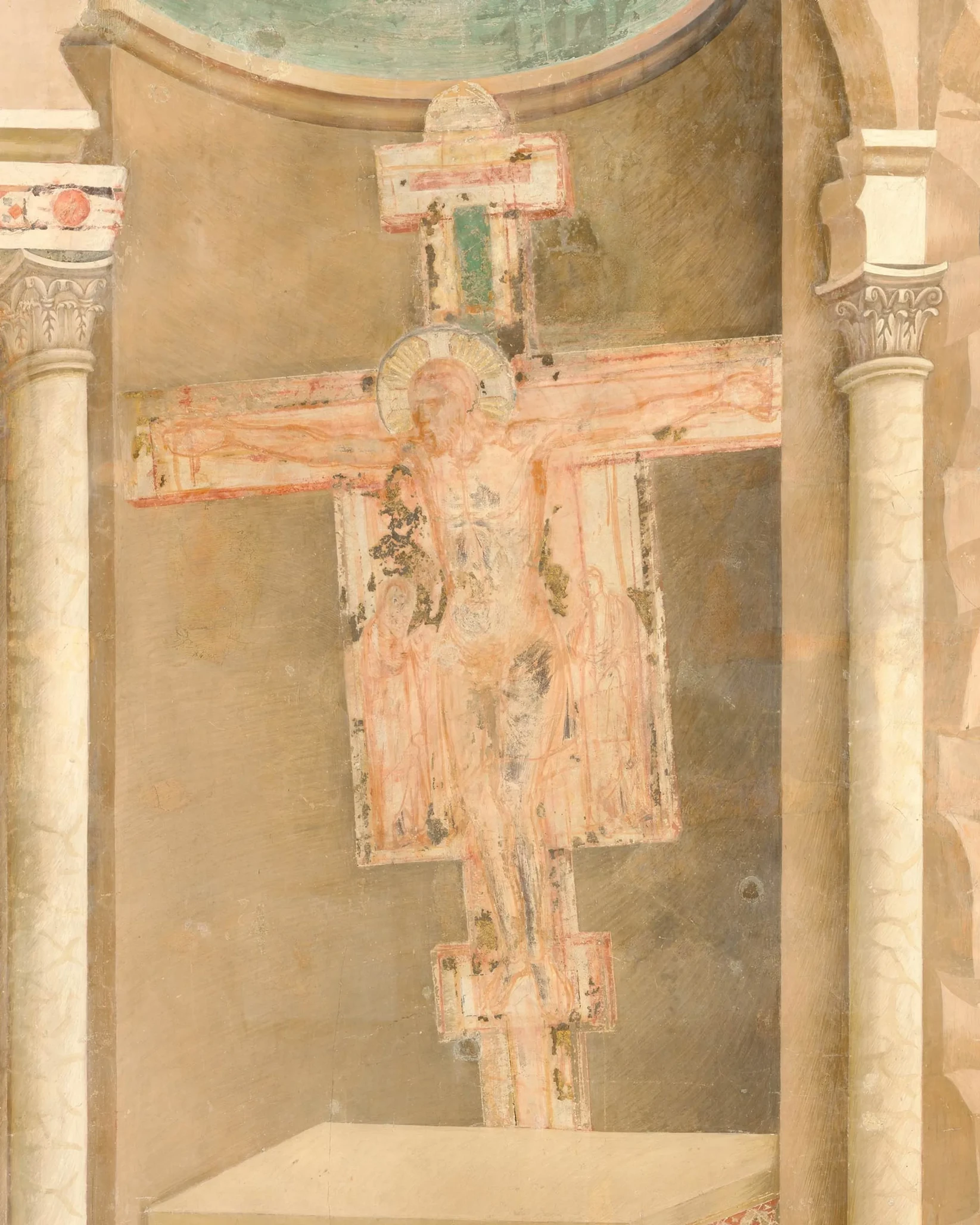
The scene recalls a pivotal moment in Francis’s life. Francis withdraws to the ruined church of San Damiano and prays before the crucifix. From the image, he hears a voice telling him to “repair my Church”.
The building is shown as a damaged, open structure, with sections of wall and roof missing, exposing the interior framework, the roof trusses and the apse. Giotto renders the church with striking naturalism, viewed obliquely so that we can look inside while still observing the scene from outside.
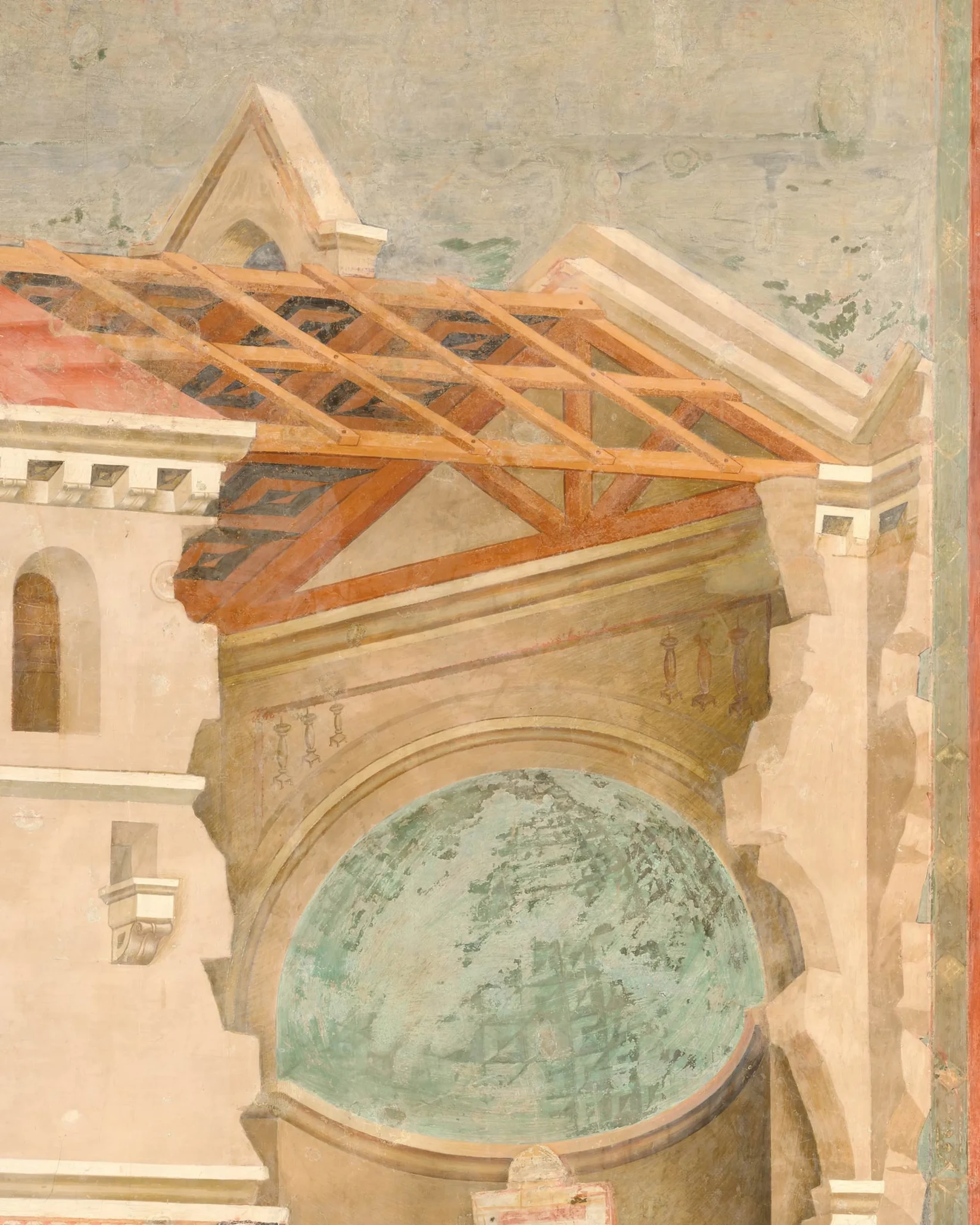
Everything, however, draws the eye towards a single point: the crucifix, the focal point of the composition. Francis kneels before this sacred object, depicted naturalistically as a painted crucifix of the late thirteenth century, in a relationship that needs no further narrative detail. The surrounding space is there simply to make the setting believable and draw us into the scene.
Giotto reduces the scene to its essentials: a man, a crucifix and the ruined church that contains them.
Liturgical furnishings in the Institution of the Crib at Greccio
In the Institution of the Crib at Greccio, attention shifts to the interior of the church and to the objects that define and organise the space.
The marble pulpit and the large wooden lectern structure the interior, dividing it into distinct areas and helping to make their different uses clear. The church becomes a space that the eye can move through. It is the physical presence of these objects, their weight, materials and solidity, that gives the scene its striking sense of reality.
The viewpoint reinforces this sense of reality. We see the scene from the choir, beyond the choir screen, an unusual vantage point that reveals parts of the church normally hidden from view. The effect is to make the interior feel like a real space that we ourselves could step into.
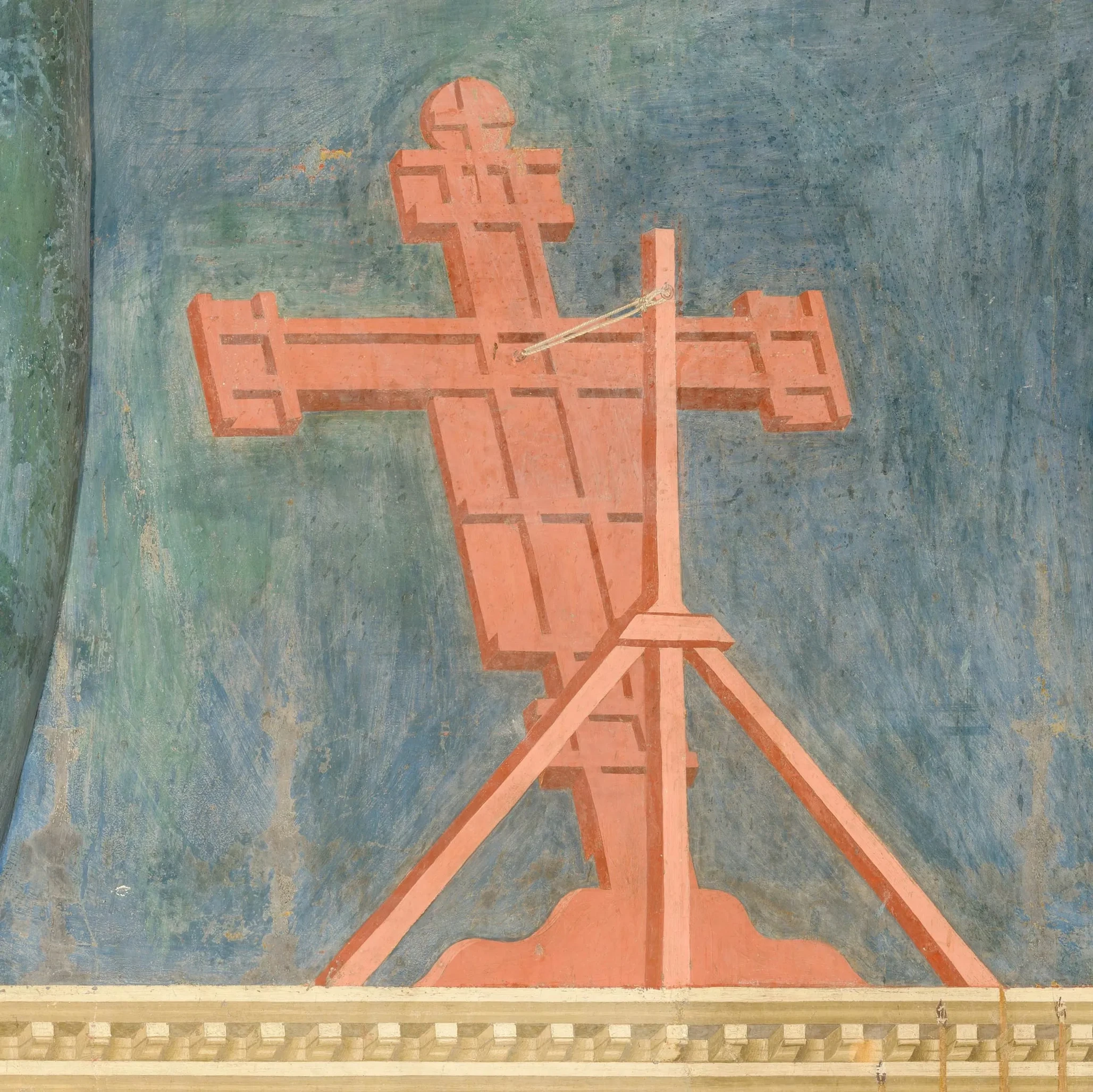
From this viewpoint, the crucifix is seen from behind, its wooden framework fully exposed, making it feel like a physical object with real weight and substance. Its tilted position, hanging out over the nave and suspended by a rope, further reinforces its physical presence within the space.
Confirmation of the Rule, Saint Francis Preaching before Honorius III and Apparition at Arles: Giotto’s spatial boxes
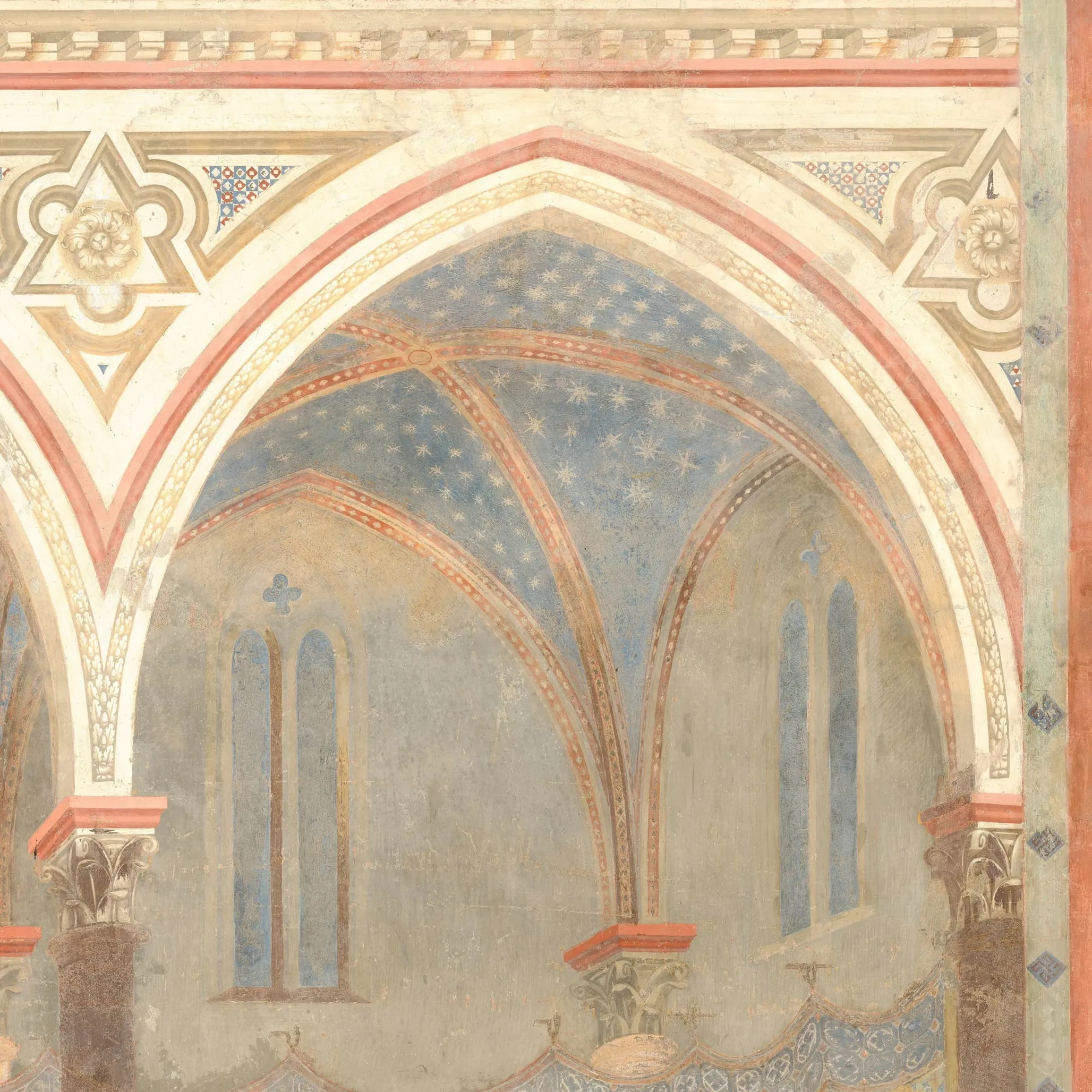
In the Confirmation of the Rule, Saint Francis Preaching before Honorius III and Apparition at Arles, Giotto creates carefully constructed spatial boxes that open up before the viewer.
In the Confirmation of the Rule, the architecture is handled with remarkable coherence. Above the figures, the vaults rest on corbels, while perspectival foreshortening gives the interior a convincing sense of depth. The figures are arranged across several planes, some set further back within the room than others. The result is an expansive, solemn interior, perfectly suited to the formality of the event taking place within it.
In Saint Francis Preaching before Honorius III, this approach becomes even more evident. The setting resembles a room opened up to the viewer, its slender columns dividing the figures into clearly defined groups.
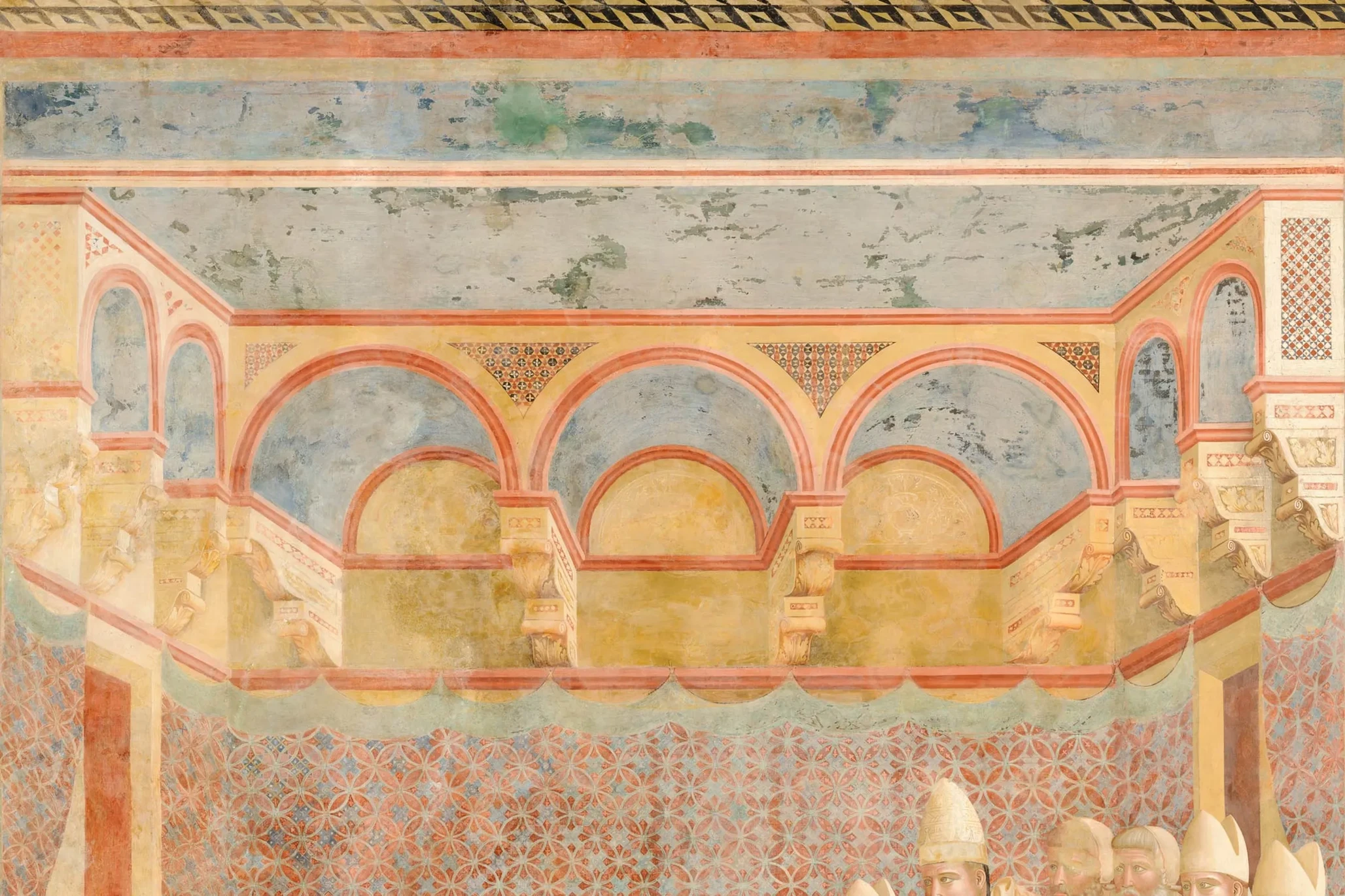
The groin vaults, rendered using intuitive perspective, give the composition both depth and rhythm.
The architecture also makes the relationship between Francis, the Pope and the papal court immediately clear. Everything is compact and carefully ordered, creating an appropriate setting for an official encounter.
In the Apparition at Arles, the architecture becomes lighter and more spacious, allowing Giotto to accommodate a larger group of figures without losing clarity. Arches, two-light windows and the bench on which the friars are seated guide the eye through the scene and give each figure a clear place within it.
Once again, the architecture helps organise a collective action and makes the event easy to follow. Even a detail such as the sloping roof glimpsed through the windows strengthens the sense of depth and extends the space beyond the interior.
The religious interior becomes an ordered, believable space that opens up to the viewer and brings together everything taking place within it.
The reality of sacred space
Giotto treats sacred space as a real environment, somewhere that can be entered, inhabited and moved through. Within these perspectival interiors, liturgical objects and human figures work together to give the action meaning.
It is this sense of physical reality that makes the images so compelling. The liturgy takes place in spaces where people move, speak, sing and pray.