Giotto’s cities: between real architecture and constructed spaces
With Giotto, sacred stories no longer unfold against undefined backgrounds but take place within the city. Squares, buildings and towers evoke recognisable places, carefully arranged to give the narrative clarity and structure. The story of Saint Francis is thus rooted in the real world and unfolds within the spaces of everyday life.
The city changes with the narrative, taking on a different role in each scene according to what Giotto chooses to show.
Assisi: the real city
In the Homage of a Simple Man, the scene is set in the main square of Assisi, a place that would have been immediately recognisable to viewers at the time and remains so today. The Temple of Minerva and the Palazzo Comunale with its tower locate the episode firmly in the heart of the city.
It is important to begin here because, at this point in the story, Francis is still part of the life of the city. He crosses the square as a young man of Assisi, fully at ease in his urban surroundings. It is here that the gesture which gives the scene its title takes place: a simple man lays his cloak before Francis as he passes, becoming the first to recognise something in him that others have yet to see.
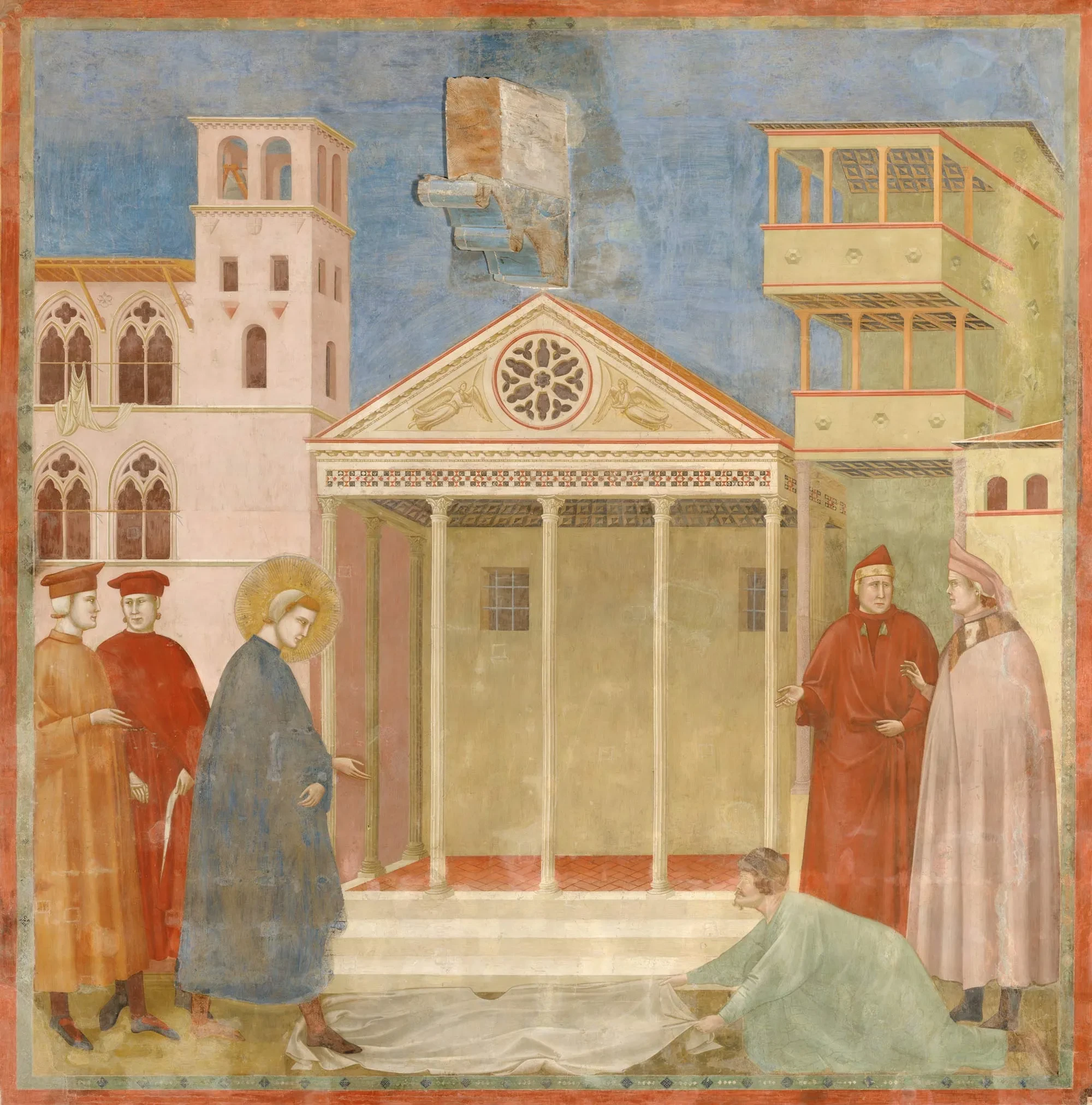
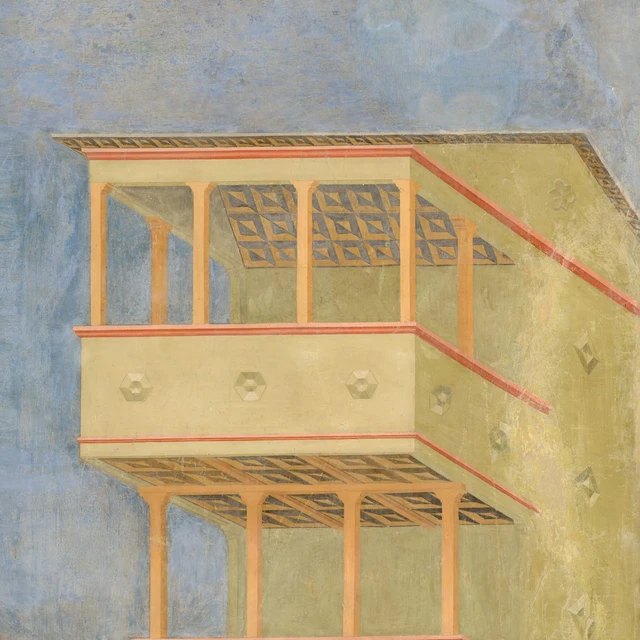
Architecture is central to the scene, giving the square the feel of a real, inhabited place. The buildings form a convincing urban backdrop, while details such as the projecting balcony on the right give them a stronger physical presence without distracting from the gesture unfolding before the passers-by.
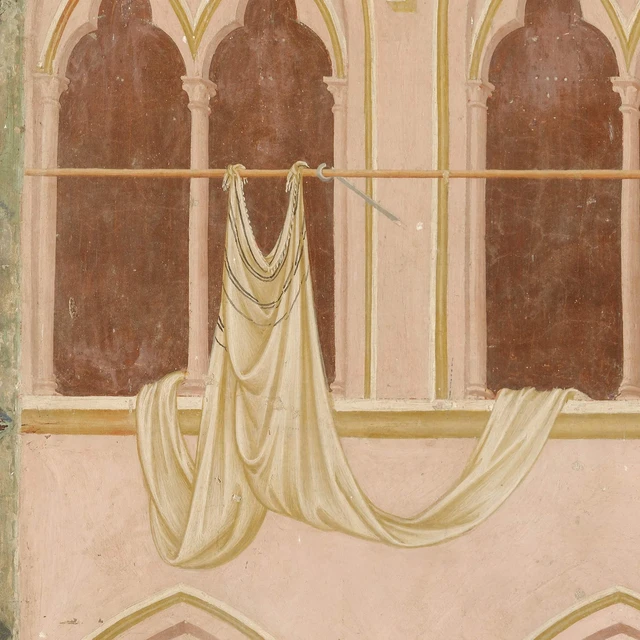
A small but revealing detail brings the scene even closer to everyday life: a piece of cloth hanging from the Palazzo Comunale. It is a simple touch, but enough to make the square feel lived in rather than idealised, a place where the ordinary routines of daily life continue around the events taking place.
The square: public space and conflict
In the Renunciation of Worldly Goods, the scene remains within the city, but the role of the square has changed. It becomes a place where everything happens in full public view. Francis’s gesture takes place before the whole community, making it an unmistakably public act.
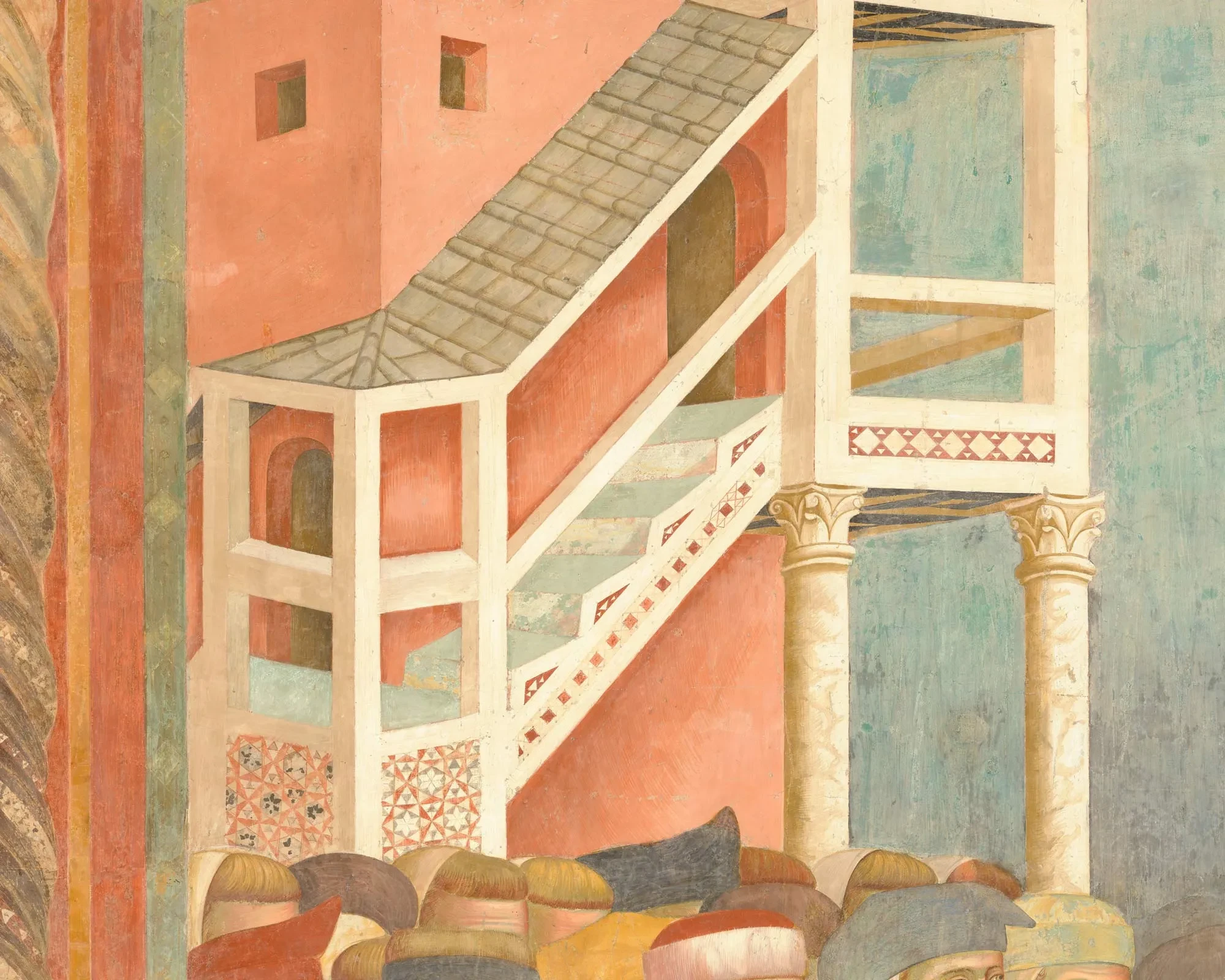
The buildings act almost like stage sets, framing the action and drawing attention to it. They open out and project forwards, creating a convincing sense of depth. Rising above the figures, they form a complex arrangement of solid forms and open spaces, as in the terrace on the right, supported by single columns.
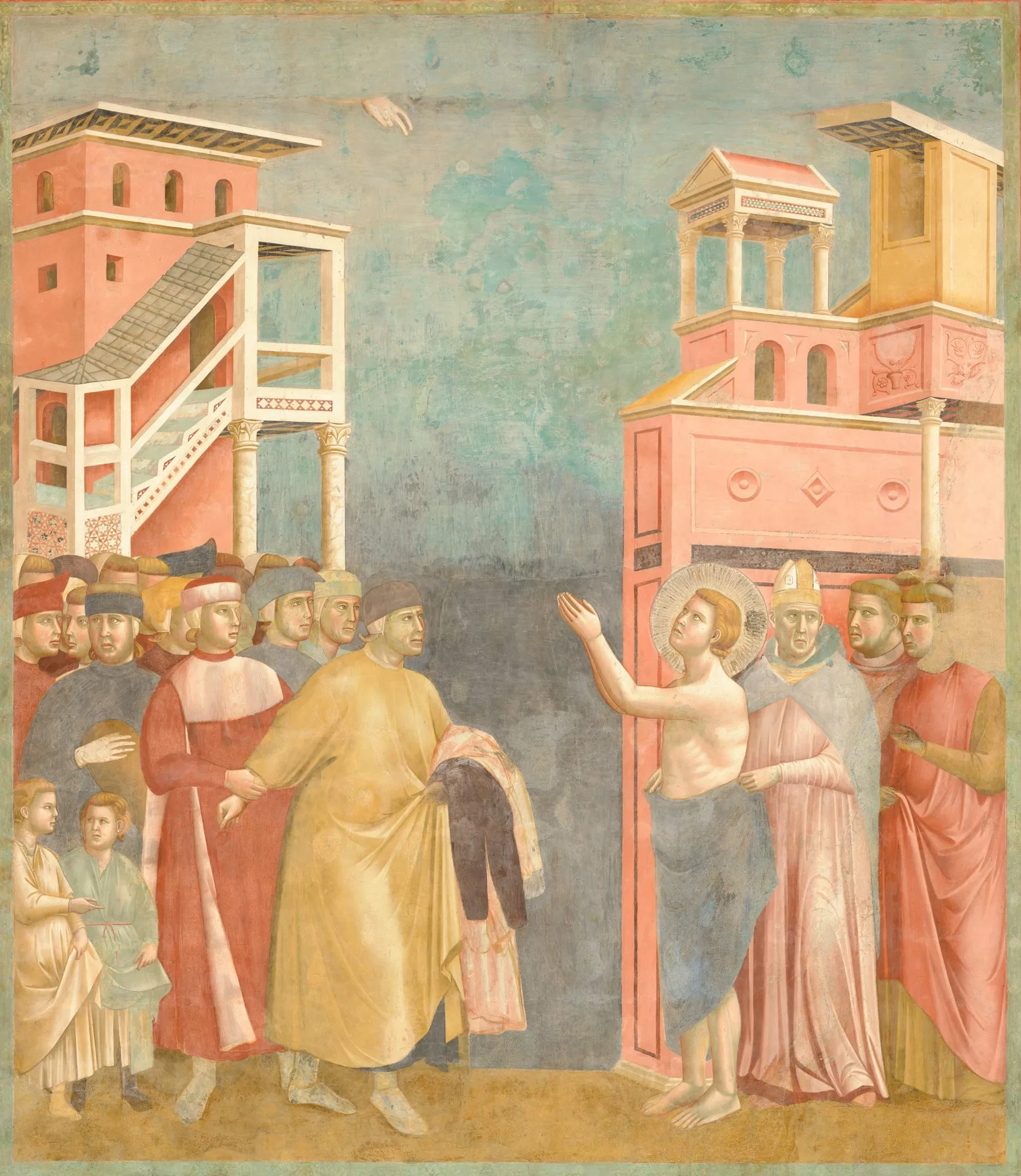
Even the slight inconsistencies in the construction of the space, such as the external staircase on the left with its unevenly aligned steps, show that strict perspectival coherence was not the aim. Everything is arranged to create an urban stage for the action.
Within this setting, the conflict is immediately clear: the father on one side, Francis on the other, and the city gathered around them. The space heightens the tension and places it within an urban setting that would once again have been instantly recognisable to contemporary viewers.
Arezzo: the city as mass
In the Expulsion of the Demons from Arezzo, the treatment of the city changes again. The buildings are packed tightly together into a dense cluster of forms: towers, houses and adjoining blocks combine to create a single mass of pastel colour.
The city is enclosed within its walls, which define its boundaries with particular force. Inside, towers and buildings crowd together, overlapping and interlocking so that almost no empty space remains. The forms seem almost to anticipate the experiments of twentieth-century Cubism, with the individual buildings brought together into a tightly compressed whole.
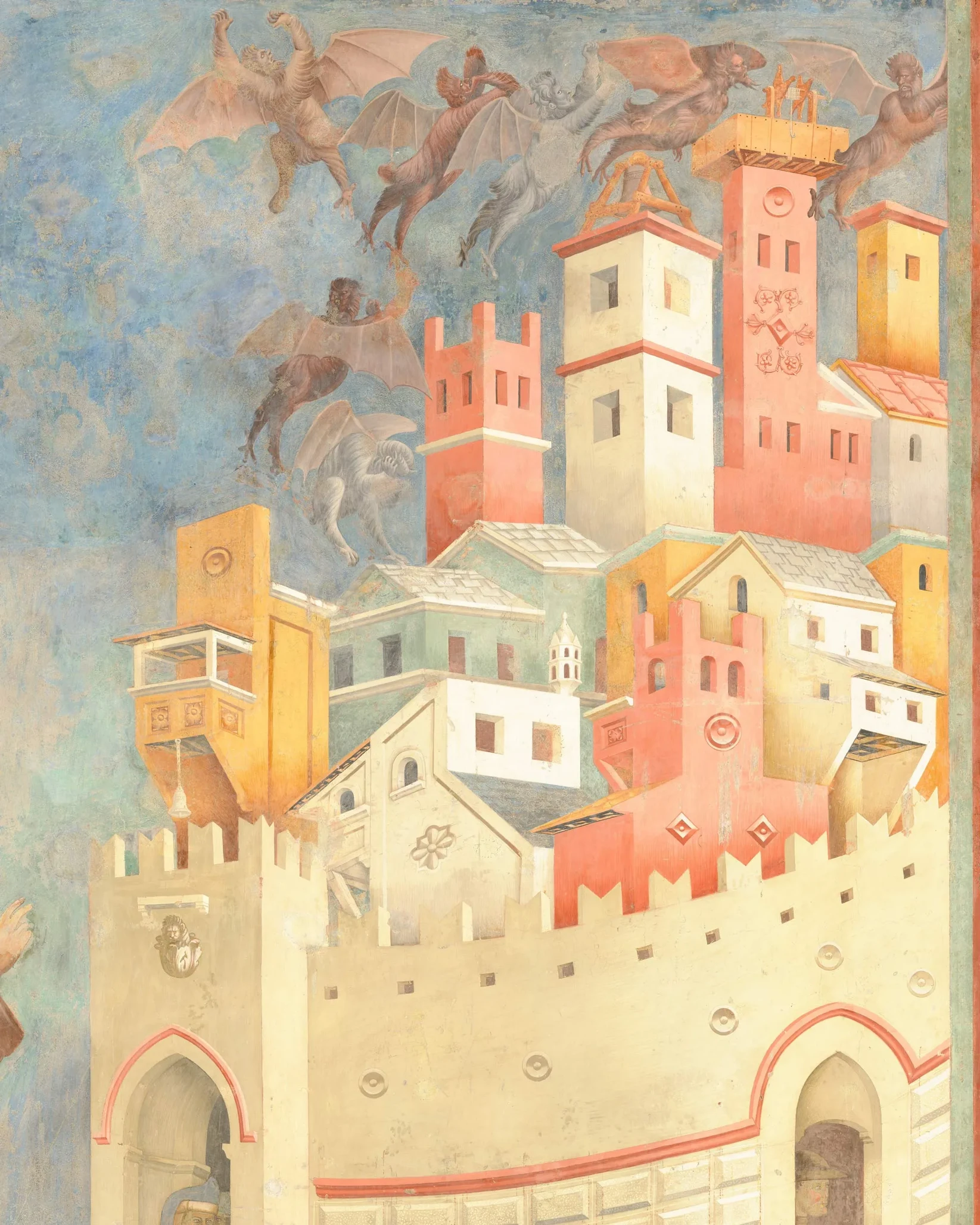
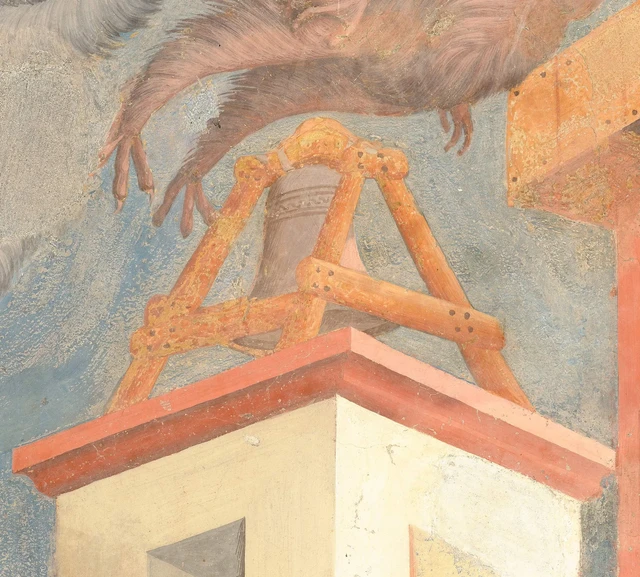
Within this dense mass, remarkable details emerge: balconies, wooden galleries, scaffolding, and suspended bells with their ropes clearly visible. Some towers incorporate temporary structures, as though they were still under construction; others are fitted with practical features such as winches and platforms. Together, these details evoke a city still being built, tightly contained within its walls.
Above this tightly packed city, the demons sweep across the sky, disturbing the space below, while Brother Sylvester makes the gesture that drives them out.
Here, architecture gives visible form to the city’s liberation through Franciscan preaching. Hemmed in by its walls, the city appears compressed even as the demons are being expelled, and that tension runs through the entire scene. Its very compactness makes the meaning of the episode immediately clear.

Cities shaped by the story
For Giotto, the city is never merely a backdrop. It can be precise and recognisable when the narrative needs to feel rooted in the real world; it can become a stage for public confrontation when the action unfolds before the eyes of the community; and it can close in on itself when the scene needs to convey a broader sense of tension.